
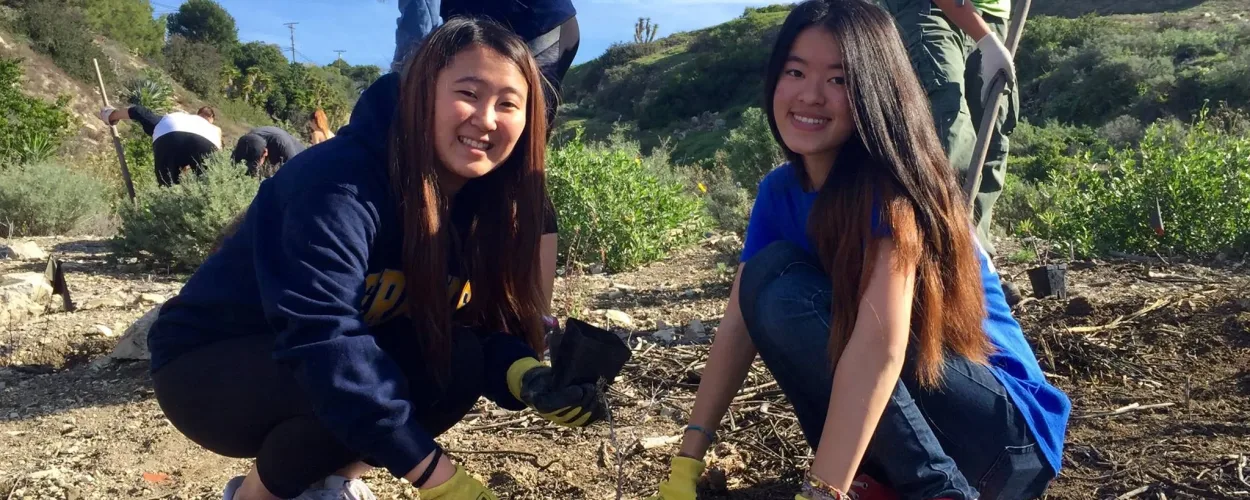
Another dry Southern California summer is a reminder of what’s at stake on the Palos Verdes Peninsula: steep canyons, coastal habitat, and neighborhoods that sit directly against open space. For more than a decade, the Palos Verdes Peninsula Land Conservancy has worked to reduce wildfire risk on the Peninsula while restoring the native habitat that makes it worth protecting — and a new grant will extend that work significantly.
The Land Conservancy has been awarded a three-year, $2.3 million grant from the San Gabriel and Lower Los Angeles Rivers and Mountains Conservancy (RMC) to fund an integrated wildfire resilience program: fuel reduction, habitat restoration, native seed production, trail accessibility, and community wildfire education.
Building on Work Already Underway
This grant builds on progress the Conservancy has already made. Since 2019, crews and volunteers have cleared invasive, fire-prone vegetation from more than 120 acres of Peninsula open space, reducing fuel loads near neighborhoods and giving native, fire-resistant plants room to reestablish.
“Wildfire resilience isn’t a single project — it’s sustained restoration, strong partnerships, and community preparedness over the long term,” said Adrienne Mohan, Executive Director of the Land Conservancy. “This grant lets us build on work already underway to reduce fire risk and restore the Peninsula’s native landscapes.”
A Three-Year Plan for Restoration, Trails, and Native Seed
Over the next three years, the grant funds restoration and maintenance of 79 acres of high-priority habitat across two preserves in Rolling Hills Estates. At George F Canyon Nature Preserve, crews will restore 51 acres and improve two miles of heavily used public trails — removing flammable invasive grasses and hazardous non-native trees, stabilizing eroded slopes, and replanting fire-resistant native vegetation to protect nearby homes and schools while keeping the preserve accessible for hikers and students.
At Linden H. Chandler Preserve, 28 acres will be restored, including the Dales Loop area bordering residential neighborhoods and a golf course, creating a fuel-reduced buffer that also restores habitat for pollinators and wildlife. In all, the grant improves and stabilizes 2.9 miles of trails while monitoring pollinator and endangered species recovery across restored sites.
The grant also expands the Conservancy’s Native Plant Nursery and Seed Farm in San Pedro by 10 acres — continuing work already underway in partnership with the California State Coastal Conservancy and the Conservation Corps of Long Beach, whose corpsmembers gain hands-on job training helping grow, harvest, and process native seed. Once complete, the expanded farm will produce between 500,000 and 750,000 native plants and seeds annually to support restoration across the region. Native, deep-rooted plants stabilize slopes, improve water retention, and suppress the invasive grasses that fuel fast-moving fires — and they sustain federally endangered species on the Peninsula, including the Palos Verdes blue butterfly and El Segundo blue butterfly.
Preparing Our Community
Wildfire resilience also depends on residents having the knowledge and tools to prepare. The grant funds guided hikes, volunteer restoration days, school programs, Firewise landscaping workshops, HOA and city presentations, and wildfire readiness training for volunteers, interns, and staff — engaging more than 1,500 residents and training more than 100 volunteers, interns, and staff annually. Working with the Los Angeles County Fire Department Forestry Division, the Conservancy will also provide practical guidance on defensible space and wildfire-safe landscaping.
“This work is about people as much as it’s about vegetation,” said Adrienne Mohan. “This grant lets us meet residents where they are and give them practical tools to protect their homes and the habitat around them.”
Why This Matters Now
The timing is significant — and so is understanding what actually drives wildfire risk here. Most wildfires nationally are started by people, not by the presence of open space itself, and most homes that burn are lost not to direct contact with a fire front but to windblown embers that land on a roof or against a wall. Native habitat isn’t the hazard either: California’s chaparral and coastal sage scrub evolved with infrequent fire, while the bigger driver of today’s elevated risk is the spread of non-native annual grasses, which dry out fast, ignite easily, and spread when frequent human-caused ignition pushes native shrubland to convert into flammable grassland in the first place.
The January 2025 Palisades and Eaton fires made that dynamic clear: both were traced to human-caused ignition sources and driven by extreme Santa Ana winds that carried embers into neighborhoods bordering open space, reshaping how Los Angeles County approaches wildfire risk in wildland-urban interface communities like the Peninsula. That’s exactly what this grant funds: reducing the fuels that carry fire, restoring native habitat that resists ignition far better than invasive grassland, and helping residents embrace native landscaping on their property as home hardening and defense — measurable work that supports both public safety and community insurability, on the Peninsula and across the region.
A Distinct Role on the Peninsula
Few organizations combine habitat restoration and wildfire fuel reduction across an entire landscape the way the Land Conservancy does on the Palos Verdes Peninsula. That dual focus — protecting a biologically significant region while reducing risk to the communities that border it — is what this grant, and the work it builds on, is all about.