
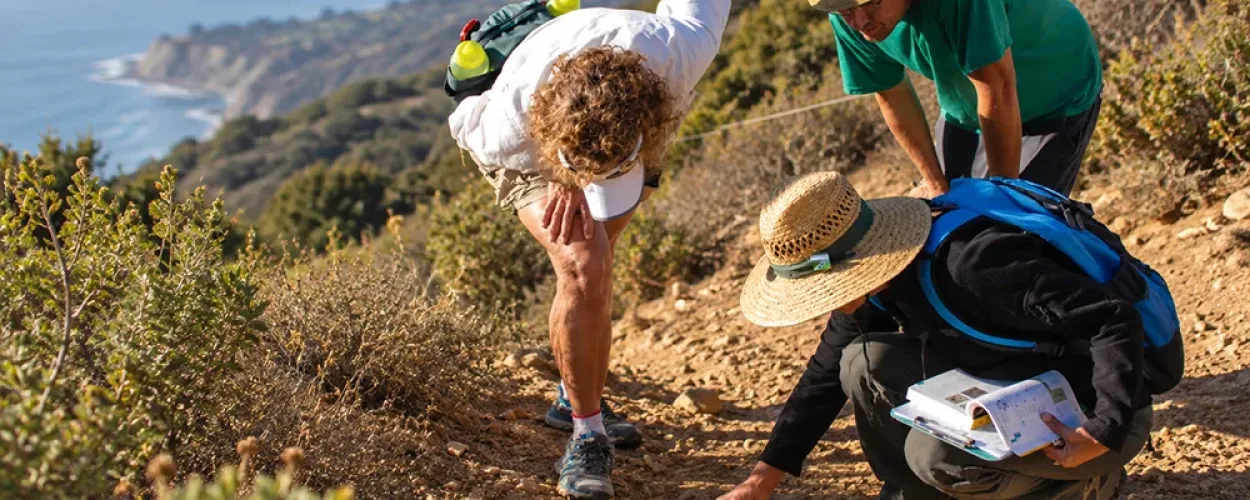
From November to March, volunteers are out on the trails — not hiking for the view, but reading the ground like a book. A fresh print pressed into damp soil. A scattering of scat near a game trail.
This is the Conservancy’s Wildlife Tracking Program, one of the more fascinating ways our community helps protect the preserves and the wildlife that call them home. Volunteers — trained and endlessly patient — monitor native and non-native carnivores across the Nature Preserve, building a picture of who’s really out there and how they’re using the land.
What the Trackers Are Finding
Wildlife tracking volunteers become adept at reading signs of mammal species on the preserves, including opossums, raccoons, cottontail rabbits, and ground squirrels, as well as the elusive gray fox and more commonly seen coyote.
These observations provide data that feeds directly into the Conservancy’s conservation planning. After three training workshops in October, monitors conduct weekly surveys on the preserves from November through March. Recent seasons of monitoring have painted a genuinely encouraging picture:
- Gray foxes are holding steady in several of the preserve’s canyon corridors, favoring dense scrub where they can den and hunt undisturbed. Volunteers have logged consistent track sets in the same general areas month after month — a good sign that habitat restoration work, including removing invasive plants and replanting natives, is providing the cover they need.
- Every track and scat sample gets logged, dated, and added to a growing dataset that helps the Conservancy understand which restored areas function as wildlife habitat, not just look good on paper. Notably, the Peninsula has no resident bobcats or mountain lions. Its carnivore community centers on coyotes, native gray foxes, and non-native red foxes, alongside raptors like hawks and owls, making tracking data on these species especially valuable.
Stitched together over months and years, the data provides evidence of what’s working—that removing invasive mustard and planting coastal sage scrub is helping rebuild a living system animals are actually using.
Why This Matters
It’s easy to assume that once habitat is restored, the job is done. Tracking data is the reality check. It tells us whether foxes are actually denning in a restored canyon, whether a new corridor is really being used, or whether an area needs more work before it can support the wildlife it was designed for.
It also gives the Conservancy something rare in conservation: a long-term, on-the-ground record of how the Peninsula’s animals are responding to years of habitat work — not a snapshot, but a story that builds season after season.
How You Can Be Part of It
Wildlife tracking is open to community members ages 16 and up — no prior experience necessary, just curiosity and a willingness to learn. Training happens in October, and after completing it, trackers join the regular monitoring rotation on the preserves from November through March.
It’s a small time commitment with an outsized payoff: you’ll learn to read the landscape like a detective, get to know the preserves’ trails in a way most hikers never do, and contribute directly to the data that helps shape how the Conservancy manages these lands.
If you’ve ever wondered what’s really moving through the canyons, this is your chance to find out—and help make sure wildlife continues to thrive there.
Interested in joining the next Wildlife Tracking Workshop this month? Sign up at pvplc.org/calendar to learn more.